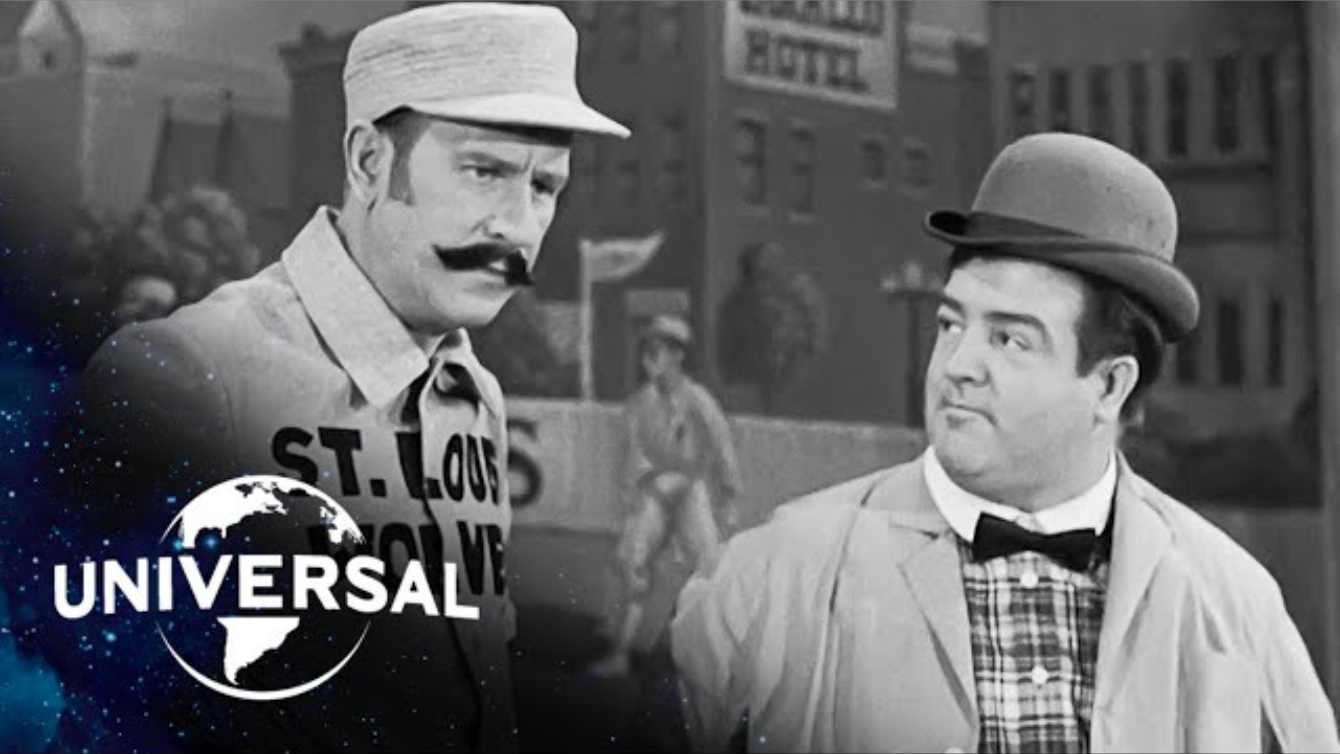
Who’s On First is perhaps the most famous comedy sketch of all time. After all these years, it still holds up. However, most people do not understand why the sketch works.
What’s the story?
Hint 1
Here’s wikipedia getting it wrong:
“The premise of the sketch is that Abbott is identifying the players on a baseball team for Costello. However, the players’ names can simultaneously serve as the basis for questions (e.g., ‘Who is the first baseman?’) and responses (e.g., ‘The first baseman’s name is Who.’), leading to reciprocal misunderstanding and growing frustration between the performers.”
The sketch isn’t funny because of the wordplay. It’s because of the story.
Hint 2
Costello’s character is the hero, and the story needs to give Costello meaningful motivation to justify his frustration and the need to stifle that frustration.
Answer
The hero is Costello (the short guy). He’s someone who wants, more than anything in the world, to play professional baseball. And he sees the coach/manager of the team, and he thinks if he could just impress this guy, if he could be noticed, maybe he would get his chance….
And he CANNOT stop screwing up, and it drives him MAD. He’s embarrassing himself in front of the one person he so badly wants to impress. Each time he screws up, he wants to run away, hide in a hole, but he can’t, he just can’t, because his dream is right in front of him, and so he stifles his shame and tries again, and again.
Even when he starts to get things right, it’s almost as bad because he doesn’t even understand what he’s getting right, and it dawns on him that he will never play professional baseball, and his dream is dead… and still he keeps trying.
And if that wasn’t bad enough… Abbot’s character keeps being nice to him. Costello might prefer to be told, “Scram, you’re wasting my time, kid,” that would at least be honest. Abbot is humoring him. It’s another layer of shame. Costello doesn’t want to be seen that way, he doesn’t want to see himself that way, and so he keeps trying and failing.
While the story is Costello’s, the secret sauce here is Abbot. This is the genius of being a good “straight man.” It’s not just that Abbot is delivering the setups and keeping a more even emotional tone. It’s that he is performing an epic “Save The Cat.” This is a modern film/TV storytelling tactic where, essentially, a character protects or saves someone (often when we first meet the character).
Typically, the hero is the one who gets the “save the cat” scene. It’s a nifty piece of storytelling here because Abbot, who is not the hero, is doing the saving, because in this case, being “the cat” is another layer of shame for Costello. This sharpens the core narrative.